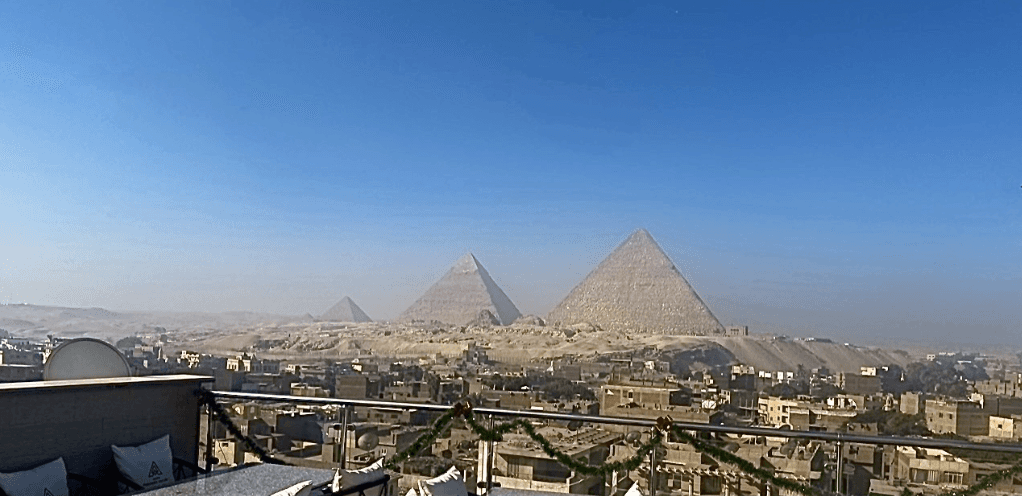
The first thing you notice when you enter the Giza Complex isn’t the famed pyramids, or the new state-of-the-art construction to make traveling around the complex easier. No, the first thing you’ll notice is the sand. So thick in the air that it almost felt tactile, as though the desert itself is trying to obscure what’s right in front of you. And maybe that’s the whole point. Maybe Egypt has always been a place that reveals and conceals in equal measure.
It was during this past Christmas, while visiting Egypt, to see what most people go to Egypt to see–the pyramids. I would learn a lesson about writing. Not about craft or structure, but about restraint. About what a story gains when it refuses to show you everything.
Until you stand directly in front of the pyramids, the sheer scale of the great pyramids is almost impossible to discern. As the pyramids are, without a doubt, one of the most monumental feats of human engineering. Yet, while standing there in that haze of sand, so thick, that you could almost taste it, the thing that most struck me wasn’t the grandeur of what had survived. It was the sheer volume of what hadn’t.
For example, while simply walking through that arid plateau, you’ll see broken obelisks jutting halfway out the ground at odd angels and temples still half buried, with inscriptions sanded down by centuries of sediment, casting a sense of the vastness that still lies unexplored and undiscovered, and that the pyramids are not a complete record, but instead a fraction of human history that has clawed its way to the surface. And once you see it that way, you can’t unsee it. And that the whole complex becomes less a monument to what we know and more a testament to the vastness of what we don’t know.
Even when scaling upwards into the narrow tunnels of the pyramids, with its smooth un-inscribed walls and precision-cut stones, it just raises even more questions of how any of this was possible.
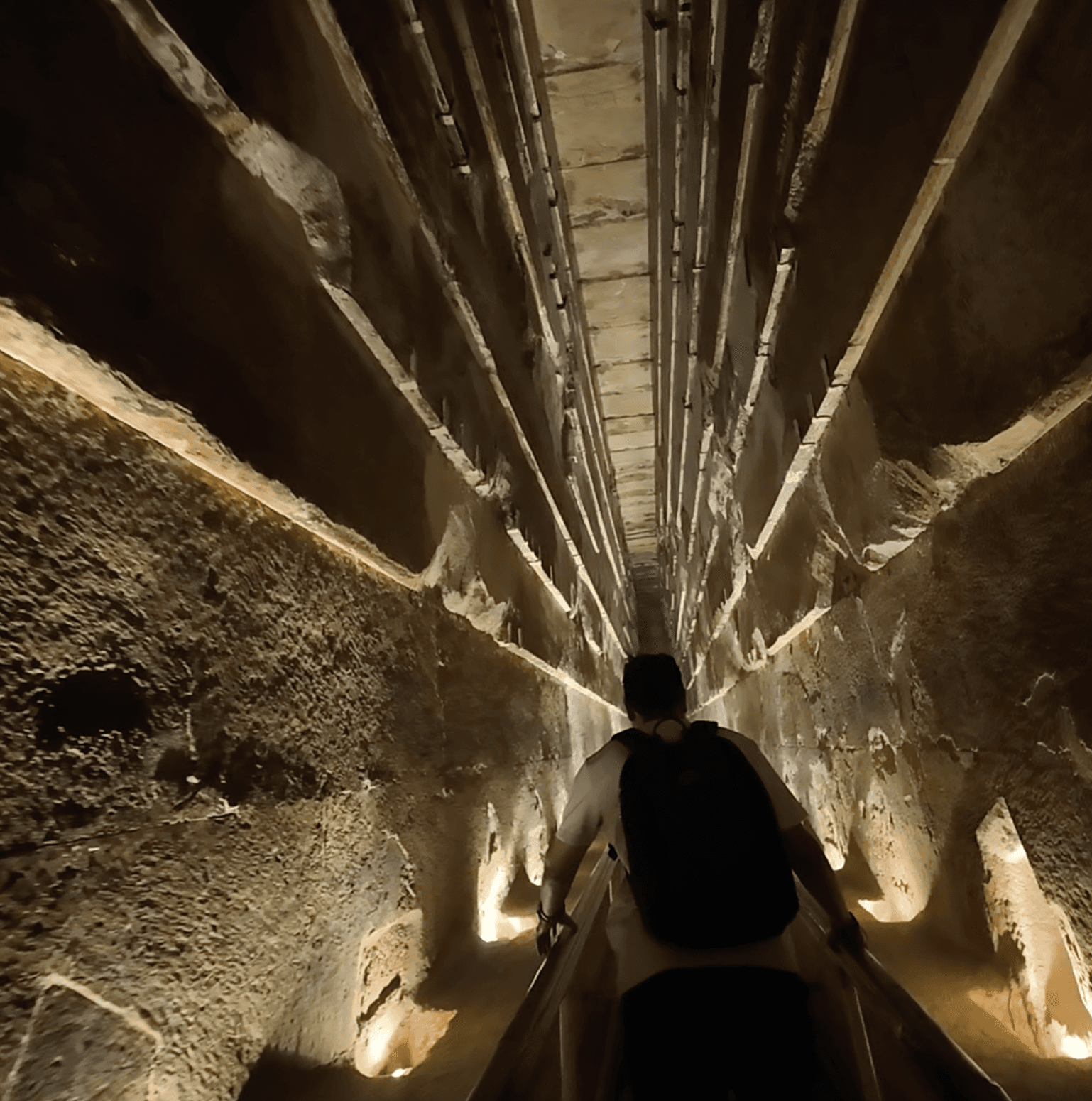
As the interior passages of the Great Pyramid are nothing like what you’d imagine from the outside. As there is no grandeur along those narrow tunnels, no etched hieroglyphs, just compression. With its steep angles and low ceiling that forces you to hunch down, nearly crawling to reach the very top.
And what unsettled me wasn’t just how it was built, but how little it chose to say
And it is that unknowing that I quietly drew the parallels between the pyramids and storytelling. That in most cases, the best stories are the ones that refrain and hold back, causing the reader or listener to naturally lean forward, to try and figure out what lies in the in-between.
That's what Egypt felt like to me, walking into a space caught in the in-between. Yes, there was bustling Giza filled with its endless shopkeepers, and vendors hawking their goods, and then there was this complex of sand and stone with its half-written story patched together with history, but also a lot of speculation braided on from the speculations of previous generations.
And it's that unknowing that intrigues and captures the imagination, even long after leaving a story far behind. For we all have stories that have stuck with us. Stories that remain forever etched into the corner of our minds.
Afterward, while sitting in a French patisserie nestled with the Giza complex, which honestly felt both absurd and inevitable.

A quiet thought would come to me.
That, whatever still lay underground, would likely remain there for another millennium.
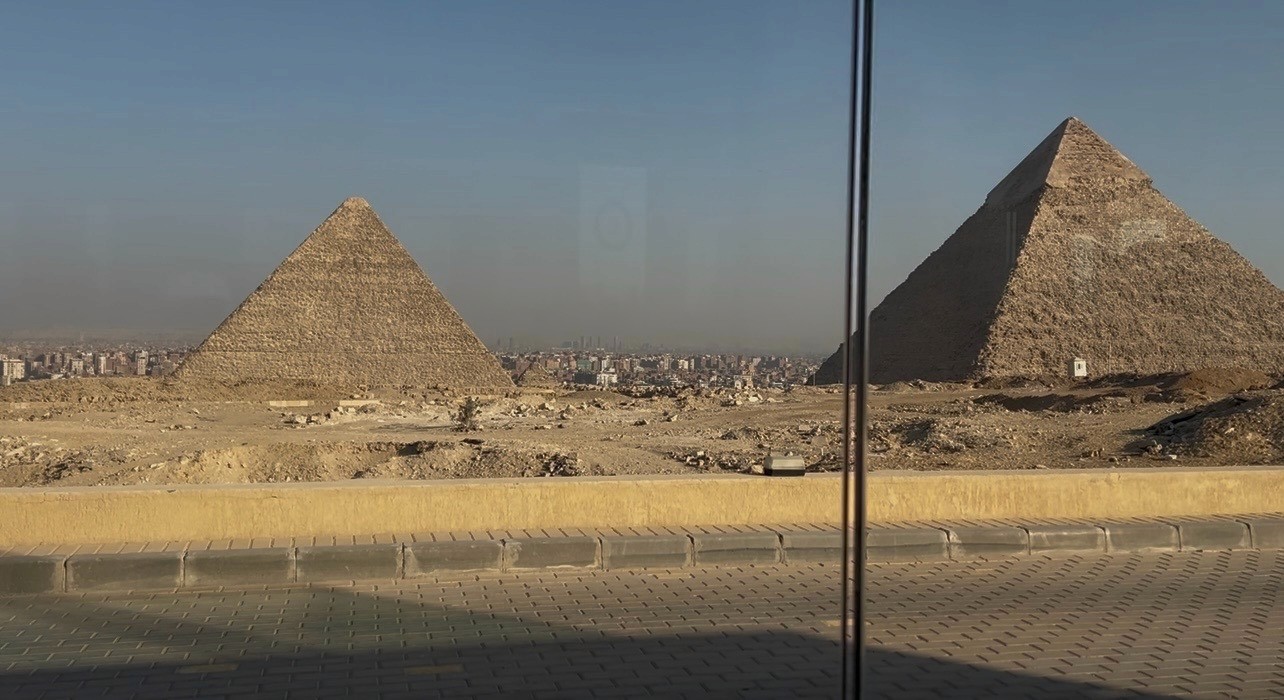
Not because we can’t excavate it, but because there's simply just too much buried. That Egypt is not a place that has given up its story easily. It is a place that has given us just enough to keep us leaning forward.
As a writer, I’ve always been drawn to the unseen, to the stories that live in gaps and silences, and in the things characters don’t say, and narrators don’t explain.
And in Egypt, I found that impulse physically. To experience the power of restraint. Not absence, but restraint. A deliberate choice to let the unknown do the work.
Egypt is, in the end, a story refrained. And it has been telling that story for thousands of years to anyone willing to lean in and listen.